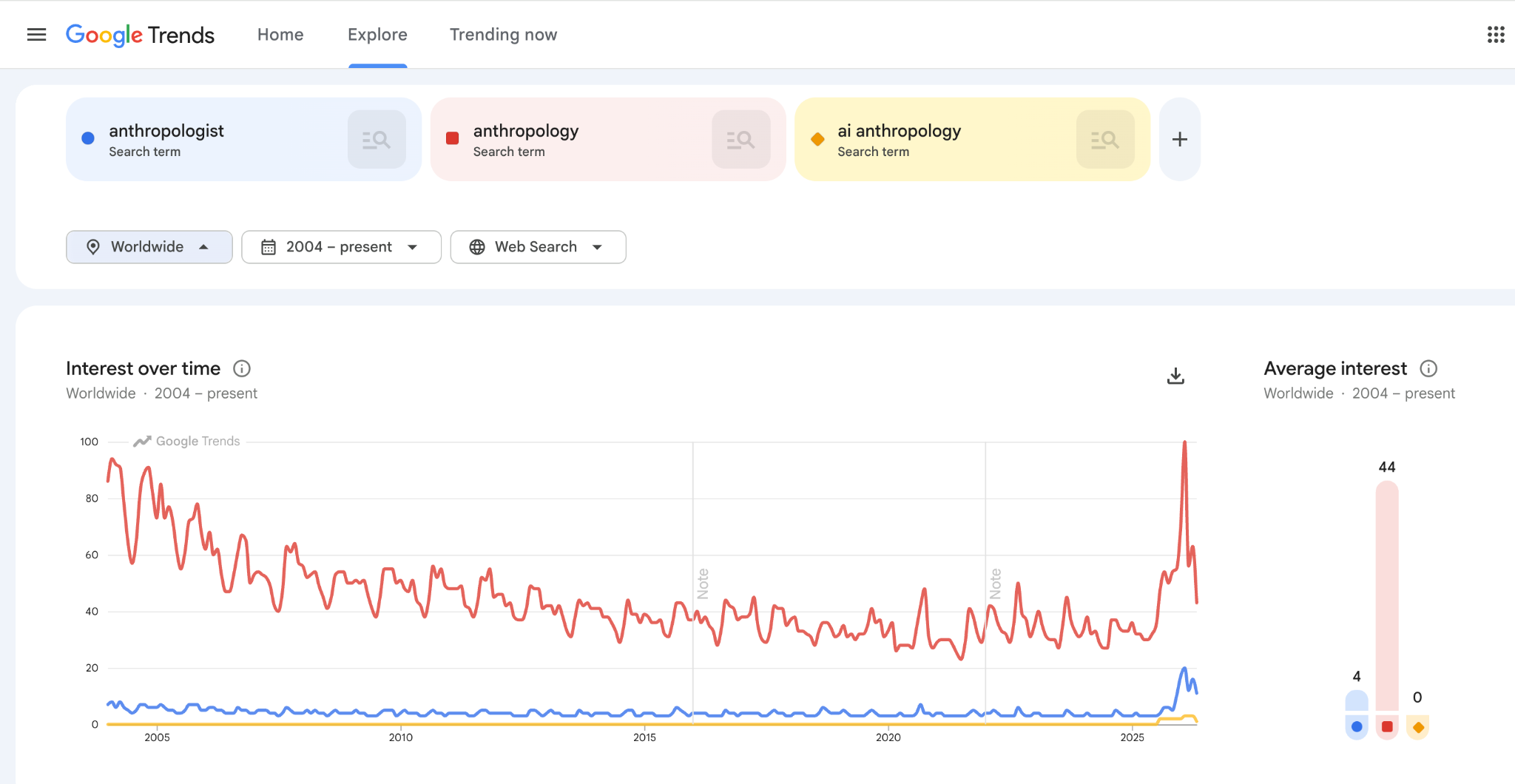
In February 2026, Google searches worldwide for the word anthropology hit their highest point since the data series began in 2004. The yellow line for AI anthropology, brand new, started registering for the first time. The line for anthropologist climbed too, on a smaller scale. Three words, three trajectories, all moving in the same direction at the same time. I have been thinking about why.
What anthropology actually is
Most people who studied anthropology at school remember it as the subject with the bones, or with Margaret Mead in Samoa, or the one that comes up when someone on TV says “Indiana Jones type”. That is two generations out of date.
Anthropology today is the systematic study of what it is to be human – across times, places, classes, professions, communities, and now software. The unit of analysis is people in their actual settings. The method is to go there. The anthropologist sits in the village, in the open-plan office, in the school playground, in the customer-service call centre, in the AI lab – and pays attention long enough that the assumptions she came in with stop dominating what she sees.
Three terms come up often. Emic is the insider’s view on how the people in the room understand what they are doing, in their own words. Etic is the outsider’s view – the analytic categories the researcher brings from outside. Good ethnography is the moment-by-moment work of holding both at once. Human agency is the question of whether a person is doing something or being done to, and the anthropologist is professionally suspicious of any answer that gets to “being done to” too quickly. If you have heard those three words more this year than ever before, you are not imagining it.
The chart
If you have ever wondered whether a discipline can have a comeback, look at the Google Trends data for anthropology worldwide over the last twenty-two years. The red line declines through the 2000s, plateaus through the 2010s, and then, in February 2026, jumps to its highest single monthly value since Google started tracking the term. The blue line for anthropologist climbs in parallel. The yellow line for AI anthropology barely existed before this year and has just started to register.
Search trends are a crude instrument. They tell you what people typed, not what they read or thought. But a 22-year peak is hard to dismiss as noise. Something is making the word feel newly relevant.
I think it is AI.
What the chart confirms
The chart confirms what I have been hearing in the rooms. Over the last year, in conversations with senior tech leaders and designers – at organisations including NASA, IBM, and Anthropic, among many others – the ethics discussion has been leaning heavily on anthropological perspectives. The vocabulary I am about to describe is not arriving from a textbook. It is arriving from the people building the next decade of AI, talking to each other in working groups, conference corridors, and pilot reviews. The Google Trends spike is the public-facing trace of a much louder conversation that has been happening in private for at least eighteen months.
Why the tech industry has been quietly hiring anthropologists for years
This is, in part, a public catching-up to something the tech industry has been doing since the late 1990s. Genevieve Bell, an Australian anthropologist, ran Intel’s in-house anthropology team for over a decade before founding the 3A Institute at the Australian National University to study autonomy, agency, and assurance in algorithmic systems. Microsoft, Google, IBM, and the major design consultancies have all kept anthropologists on payroll for years – in research, in product, increasingly in policy.
The acceleration in the last three years has been driven by the AI safety and “responsible AI” teams. When a chatbot is being deployed to two thousand call-centre agents who have never asked for it, an engineer cannot tell the company what is about to happen. An anthropologist can. Quietly, the vocabulary has leaked outward. Human agency now appears in EU AI Act discussions and in the policy briefs that cross my desk at The Growth Company. Emic and etic are showing up in product-design seminars where five years ago you would have heard user persona. This is not a fashion. It is a slow institutional recognition that the gap between what a system is supposed to do and what people actually do with it is the thing that breaks the system.
Why AI especially
Most technologies do not need an anthropologist. Email did not. Spreadsheets did not. The ones that need one are the technologies that touch meaning – that try to read a face, classify a person, write a sentence, make a decision about a body. AI is in all four of those rooms now, and none of them are the kind of room you can analyse from outside.
For AI policy, this means the regulatory question is no longer “is the model safe in the lab?” It is “what does it do to a particular kind of person in a particular kind of setting over six months?” That is an ethnographic question. Answering it badly will get the next decade of regulation wrong.
For AI product design, every interface decision is a cultural decision. Whether a chatbot says please. Whether the default voice sounds British or American or neither. Whether the model is willing to be wrong, and how it apologises when it is. Whether it explains itself with charts or with sentences. Each of these is an emic question (what does the user actually expect?) dressed up as an engineering choice. Get them wrong and the most technically capable model in the room will fail to land.
The case for an AI Anthropologist
This site exists because the position is empty. There are anthropologists in tech. There are ethicists outside it. There are policy people in between. The person who stands publicly at the intersection – who watches both the workshops and the white papers, who reads both the ethnographies and the model cards, who can talk to a board, a coachee, and a regulator in the same afternoon – this is a role waiting to be claimed.
I am not the first to attempt it. Bell’s institute in Canberra is the gold standard, and there are good people in this space already. I am writing here because the position needs more public, plainer-English voices – not only the academic ones. Most of what I write will be slow essays. Some will be commentary on news as it breaks. All of it will share an assumption: that the most important question about AI is not what the model can do, but what we will do with it, what it will do to us, and how we make it through the next decade with our humanity intact.
If anthropology really is the fastest-rising humanities word of 2026, the question is not whether the line will keep climbing. It is whether the discipline behind the word will be heard in the rooms where the next decade of AI is being designed, before the products ship, not after the harms.
Further reading
This is the start of an ongoing list, not a closed canon. The series will draw from AI engineering, anthropology, business ethnography, social phenomena, and philosophy as it develops – and the reading list will grow with it. These six are where I happen to be reading right now.
- Genevieve Bell and Paul Dourish, Divining a Digital Future (MIT Press, 2011). The closest precedent for the position this site claims.
- Sherry Turkle, Reclaiming Conversation (Penguin, 2015). On what the technology displaces.
- Onora O’Neill, A Question of Trust (Cambridge, 2002). The philosophical anchor for any serious treatment of trust.
- Yanis Varoufakis, Technofeudalism: What Killed Capitalism (Bodley Head, 2023). The political economy of cloud capital, in plain language.
- Kate Crawford, Atlas of AI (Yale, 2021). The lithium, the labour, the data centres – AI made physical.
- James C. Scott, Seeing Like a State (Yale, 1998). The long-arc precedent: what happens when high-modernist systems meet local knowledge they refuse to see.